> For the complete documentation index, see [llms.txt](https://support.limy.ai/llms.txt). Markdown versions of documentation pages are available by appending `.md` to page URLs; this page is available as [Markdown](https://support.limy.ai/onboarding/intro-to-limy.md).
# Intro to Limy
This article explains what Limy is, how it works, and how you can use it to understand and improve your brand’s visibility across AI-generated search results.
### What is Limy?
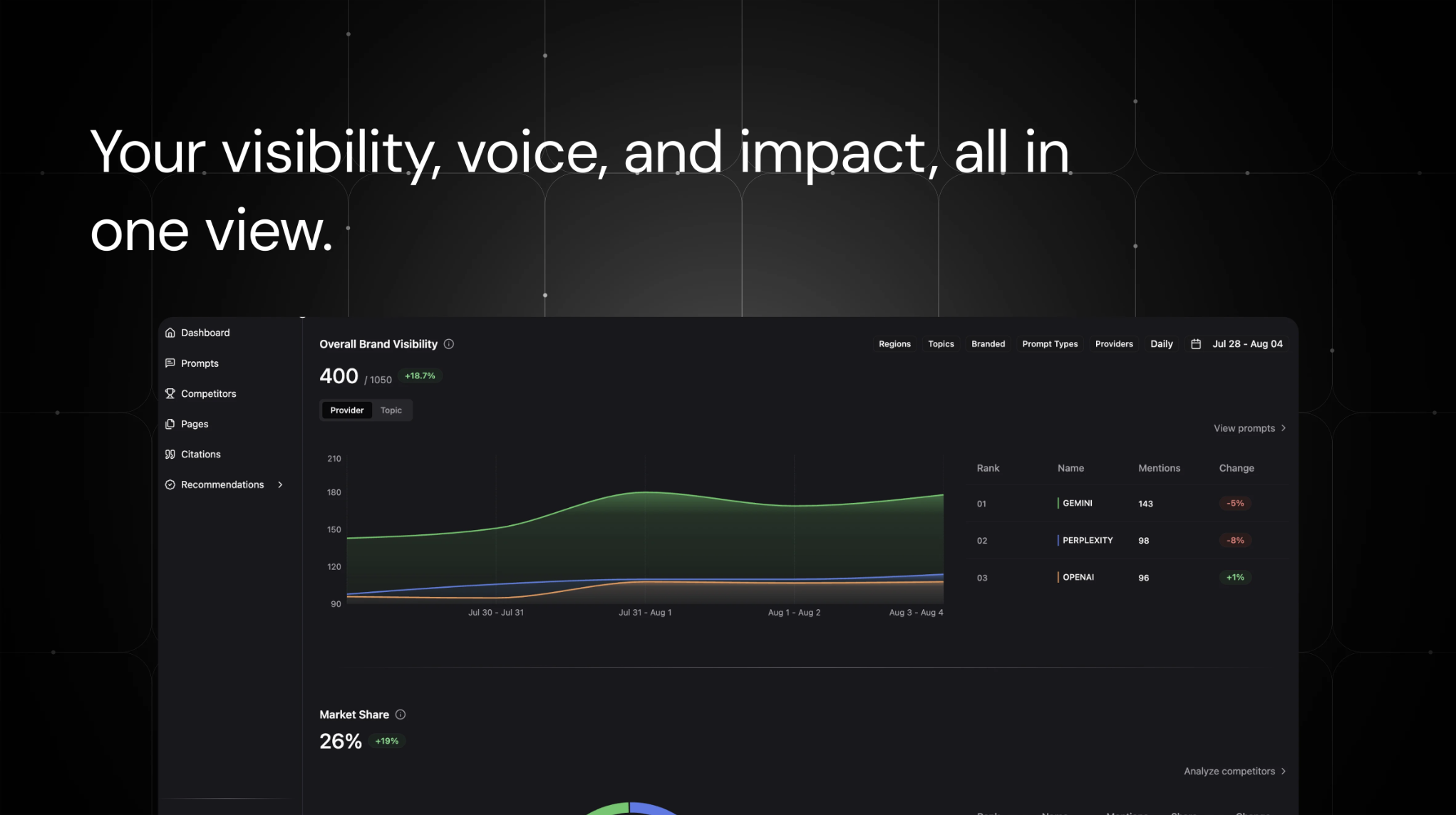
Limy helps companies understand how their brand appears in AI-generated search results.
It analyzes responses to tracked prompts and shows brand visibility, competitor presence, sentiment, and cited sources. Limy also provides recommendations to help teams improve their presence across AI search platforms.
***
### Prompts: How AI Search Is Analyzed
Prompts are questions Limy tracks to evaluate how AI platforms respond to topics related to your brand. They are created using your industry, selected topics, and target personas.
{% hint style="info" icon="comment-lines" %}
For each prompt, Limy reviews the AI-generated response, including brand mentions, competitor presence, sentiment, and cited sources. This helps you see where your brand appears and where coverage may be missing.
{% endhint %}
***
### What Limy Measures
{% hint style="warning" icon="ruler-horizontal" %}
Limy measures AI visibility across key dimensions, including overall brand visibility, market share versus competitors, prompt coverage, sentiment, and the sources cited in AI-generated answers
Together, these metrics provide a clear view of your brand’s position inside AI-driven discovery.
{% endhint %}
***
### Recommendations: Turning Insights into Action
Limy creates recommendations based on visibility gaps, competitor performance, and source patterns.
Each recommendation explains what to improve and why it matters. For applicable recommendations, Limy also provides generated content that your team can review and edit before using.
***
### Monitoring AI Traffic and Agent Activity
Limy’s monitoring tools show two different types of website activity:
* **Agent Monitor** uses CDN request data to show which agents and crawlers access your website and which pages they request.
* **AI Traffic Monitor** uses the Limy pixel to show visits from AI engines and what those visitors do on your website.
* **Attribution** connects AI-referred visits with configured website events and, when assigned, their estimated value.
### What is the Limy Pixel? How is it different from traditional analytics?
The Limy pixel is a tracking script installed on your website. It powers AI Traffic Monitor by identifying visits from AI engines and recording website activity, including page views and configured events.
Traditional analytics tools measure traffic from many different sources. The Limy pixel focuses on visitors arriving from AI engines and helps connect those visits with actions taken on your website.
Agent Monitor is separate. It uses CDN request data to track automated agents and crawlers.
***
### How Limy Is Different
Traditional analytics tools focus on general website traffic and user behavior. Limy focuses on how brands appear in AI-generated responses, traffic arriving from AI engines, and activity from AI agents and crawlers.
Limy is designed to complement traditional analytics and SEO tools, not replace them.
### FAQ
What problem does Limy solve?
Limy helps brands understand and improve how they appear in AI-generated answers, where traditional analytics and SEO tools fall short.
How does Limy analyze AI search?
Limy analyzes AI-generated prompts and answers, tracking brand mentions, sentiment, competitors, and the sources AI systems rely on.
Does Limy replace traditional analytics or SEO tools?
No. Limy complements existing analytics and SEO tools by focusing specifically on AI-driven discovery and visibility, as more users shift from traditional search engines to AI-powered search experiences.
What data does Limy collect?
Limy collects AI-generated answer data, AI crawler behavior, and session-level user behavior from AI-driven traffic, without collecting personal identifiable information (PII).
How quickly can I see value from Limy?
You can start seeing visibility insights within days, with actionable recommendations and measurable impact developing as tracking and optimizations progress.
***
### Related Content
{% content-ref url="/pages/8oZ4sgGqI2ai6UorfN3c" %}
[Your First 30 Days with Limy](/onboarding/your-first-30-days-with-limy.md)
{% endcontent-ref %}
{% content-ref url="/pages/zJowQmeJAeUeYyWGOQjD" %}
[Scaling and Optimizing with Limy](/onboarding/scaling-and-optimizing-with-limy.md)
{% endcontent-ref %}
{% content-ref url="/pages/LoiAA6N4BPheGuTBYuCK" %}
[Dashboard Overview](/dashboard/dashboard-overview.md)
{% endcontent-ref %}
{% content-ref url="/pages/1yBjpt1M5rHVBBSlDhvL" %}
[Settings](/settings/settings.md)
{% endcontent-ref %}
Still have questions? We’re here to help. Contact us at **** - we’d be happy to assist.