> For the complete documentation index, see [llms.txt](https://support.limy.ai/llms.txt). Markdown versions of documentation pages are available by appending `.md` to page URLs; this page is available as [Markdown](https://support.limy.ai/intelligence/sentiment-score-analysis.md).
# Sentiment Score Analysis
This article explains how sentiment analysis works in Limy and how to identify and address negative or inconsistent AI framing of your brand.
### Overview
Sentiment Analysis shows **how AI systems describe and frame your brand** within AI-generated answers.
When AI platforms generate responses about your brand, they do more than reference facts. They apply tone and context - positive, neutral, or negative - based on the sources they ingest and the narratives they infer. Over time, this framing shapes how users perceive your brand before they ever interact with your website or content directly.
Sentiment Analysis in Limy allows you to understand how AI systems *talk about* your brand, identify where negative or inconsistent framing exists, and take targeted action to improve brand perception across AI-generated answers.
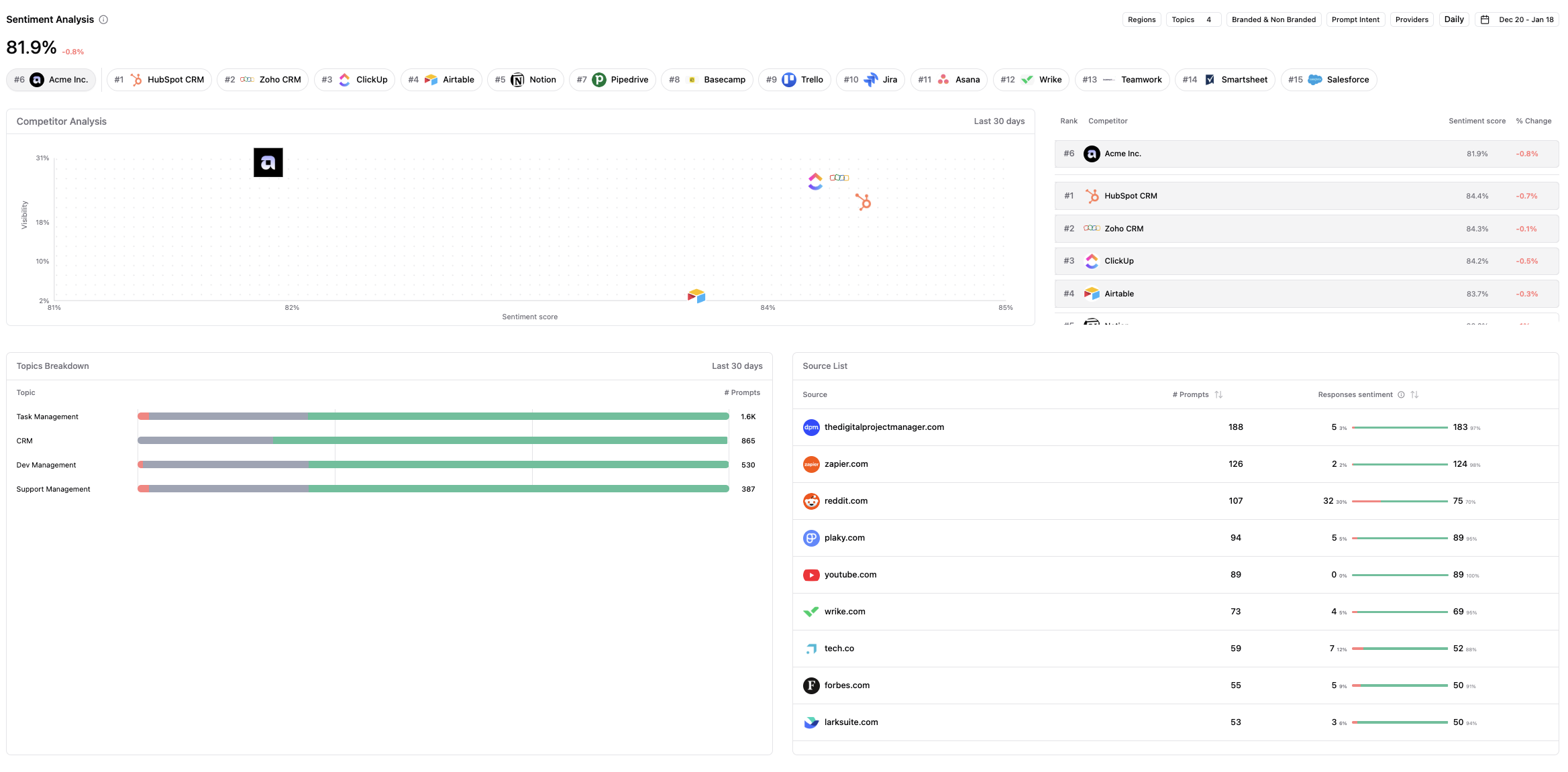
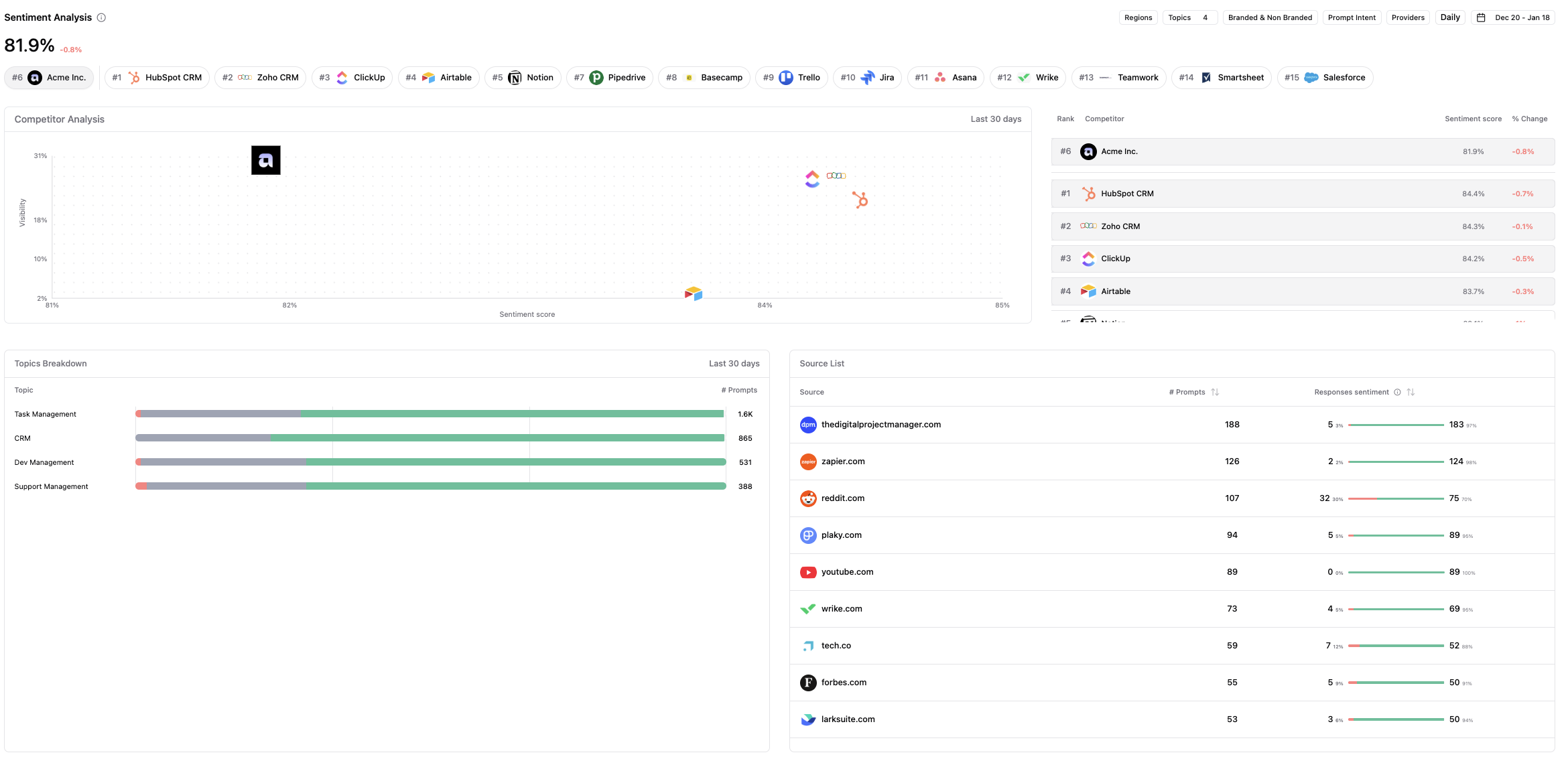
You can access Sentiment Analysis from the **Sentiment** page in the left navigation. Sentiment insights are also available directly within the [**Dashboard**](/dashboard/dashboard-overview.md) and at the [**individual prompt level**](/intelligence/sentiment-score-analysis/sentiment-analysis-prompt-level.md), allowing you to analyze brand perception across high-level trends and specific AI-generated answers.
***
### What Sentiment Analysis Shows
Sentiment Analysis allows you to:
* See an overall sentiment score for your brand
* Track sentiment trends over time
* Analyze sentiment at the **prompt level**
* Compare sentiment across competitors
* Identify prompts and sources driving negative or positive framing
Sentiment is measured on a **0–100 scale**, where:
* **0** represents strongly negative framing
* **100** represents strongly positive framing
This score reflects **AI-generated language**, not customer reviews or social sentiment.
***
### How to Access Sentiment Analysis
You can access Sentiment Analysis in multiple places within Limy:
1. Directly within the **Dashboard**
2. From the **Sentiment** page in the left navigation
3. At the **individual prompt level**
***
### How to Use Sentiment Analysis
#### Step 1: Review overall sentiment
Start by reviewing your overall sentiment score and trend line to understand how AI framing of your brand changes over time.
This view helps identify:
* Gradual improvements or declines
* Sudden shifts caused by new sources or narratives
#### Step 2: Analyze sentiment at the prompt level
Click into individual prompts to see how sentiment is expressed within specific AI-generated answers.
Prompt-level analysis helps you:
* Identify which topics drive negative framing
* Understand the context behind sentiment changes
* Avoid treating sentiment as a single, abstract metric
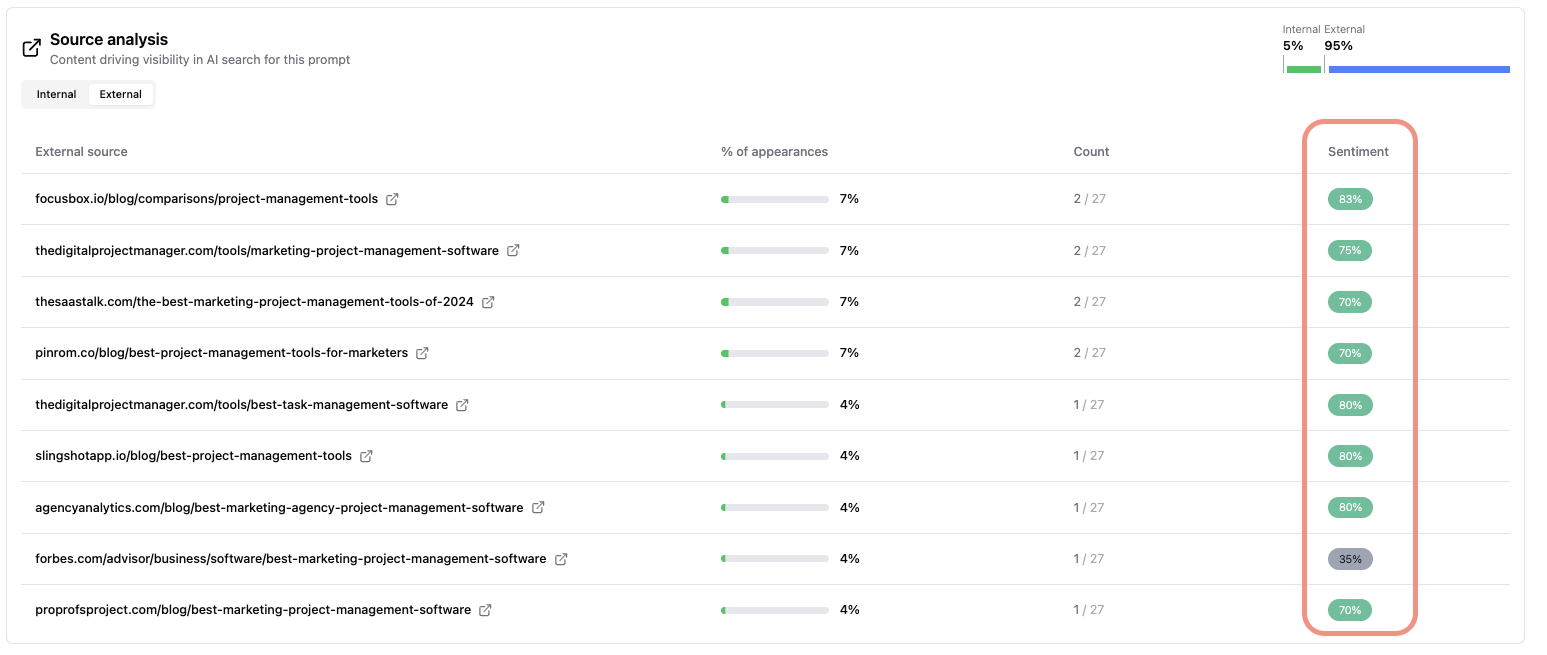
#### Step 3: Identify influencing sources
For prompts with negative or mixed sentiment, review the underlying sources AI systems rely on.
Negative framing often originates from:
* Blog posts
* Reviews
* Forum or community discussions (e.g., Reddit)
* Outdated or misleading content
Understanding these sources allows you to take **targeted corrective action**.
{% hint style="info" %}
Sentiment improvement is typically incremental and driven by **addressing specific narratives**, not publishing content at scale.
{% endhint %}
### How Sentiment Analysis Connects to Other Limy Features
Sentiment Analysis works closely with:
* **Prompts:** to identify where sentiment is formed
* **Sources & Citations:** to understand what drives framing
* **Recommendations:** to address sentiment issues through targeted actions
* **Attribution:** to evaluate whether improved sentiment correlates with outcomes
Together, these features help manage **brand perception in AI search**, not just visibility.
{% hint style="info" %}
Use **Sentiment Analysis** to identify prompts and sources where AI systems frame your brand negatively. Review the underlying content (such as blogs or forum posts) and take targeted action - like updating content or adding clarifying, positive commentary - to influence how AI systems interpret your brand over time.
{% endhint %}
### FAQs
Is sentiment based on customer reviews or social media?
No. Sentiment is derived from AI-generated answers and the language used by AI systems, based on the sources they reference.
Can sentiment change quickly?
Yes. Sentiment can shift when AI systems ingest new sources or re-interpret existing information.
How can I improve negative sentiment?
Improvement usually involves addressing the underlying sources through updated content, PR efforts, or clarifying commentary.
Should I optimize for sentiment or visibility first?
Both matter, but addressing negative sentiment on high-visibility prompts should be prioritized.
***
### Relevant Content
{% content-ref url="/pages/pXjZ5uTdnRmycIfMjELI" %}
[Sentiment Analysis: Prompt Level](/intelligence/sentiment-score-analysis/sentiment-analysis-prompt-level.md)
{% endcontent-ref %}
{% content-ref url="/pages/6kAhYKOlGBTuwcBqHfMk" %}
[Prompts Overview](/intelligence/prompts-overview.md)
{% endcontent-ref %}
{% content-ref url="/pages/LTbYDDYNgV7bSGqf9tOC" %}
[Recommendations](/dashboard/dashboard-overview/recommendations.md)
{% endcontent-ref %}
{% content-ref url="/pages/TzGDW81lHXDTZ9XHnHSe" %}
[Source Analysis](/intelligence/source-analysis.md)
{% endcontent-ref %}
Still have questions? We’re here to help. Contact us at **** - we’d be happy to assist.