> For the complete documentation index, see [llms.txt](https://support.limy.ai/llms.txt). Markdown versions of documentation pages are available by appending `.md` to page URLs; this page is available as [Markdown](https://support.limy.ai/intelligence/source-analysis.md).
# Source Analysis
This article explains how sources, pages, and citations influence AI-generated answers and how to use these insights to guide content and PR strategy.
Source Analysis shows you **which sources influence AI-generated answers** about your brand, your competitors, and your industry. You can understand what content AI systems rely on and what to strengthen to improve visibility.
AI platforms synthesize from content they’ve ingested and sources they trust. Source Analysis helps you identify the exact websites, pages, and content types shaping AI answers, making it easier to prioritize content updates, PR placements, and competitive positioning.
### With Source Analysis, you can:
* See which sources AI systems rely on when answering prompts in your industry
* Break down internal vs. external sources influencing your visibility, where you can deep dive into each source and prompts.
* Analyze source types (e.g., blog, news, reviews, docs, community)
* Identify the specific URLs that matter most
* Understand where competitors are being reinforced by strong sources
* Spot gaps where your brand lacks authoritative coverage
{% stepper %}
{% step %}
#### Log in to your **Limy** account
{% endstep %}
{% step %}
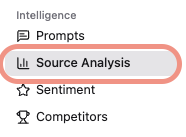
#### Navigate to **Source** **Analysis** under Discoverability
{% endstep %}
{% endstepper %}
Within each Source Analysis view, you can apply the same global filters (such as topic, branded vs. non-branded, prompt intent) to focus the analysis on the most relevant prompts.
### The page breaks sources down into:
* Internal vs. external sources
* Sources by type (for example: education, news & media, business & services)
* A ranked source list, showing each provider’s share of influence on AI-generated answers
You can click into any individual source to view every specific URL that was referenced or relied on by the AI systems when generating responses.
This makes it easy to see exactly which content is **shaping AI answers and where visibility is being reinforced.**
### Use Source Analysis for competitive strategy
Compare your sources to competitor sources to answer questions like:
* Which publications or platforms repeatedly mention competitors?
* What type of content is reinforcing their authority?
* Where do they have coverage that you don’t?
This helps you replicate what works—and close visibility gaps with targeted execution.
### With the Source Analysis, your team should be able to:
* Clearly identify which sources most influence AI answers about your category
* Understand whether your visibility is driven by your own content or external coverage
* Prioritize high-impact content updates and PR placements
* Build a measurable roadmap for improving AI authority and mention share
* Explain visibility changes with evidence (“These sources started being cited more / less”)
### FAQ
Does Source Analysis show exactly what AI systems used?
It shows the sources that appear to influence AI answers based on analysis of AI outputs and cited/reference patterns, which helps you understand what content is shaping responses.
Why are competitor sources showing up more than ours?
Competitors may have stronger third-party coverage, more authoritative citations, or better-aligned content formats (e.g., reviews, comparisons) that AI systems rely on for your category.
How should I use Source Analysis day-to-day?
Use it to prioritize content refreshes, decide where to invest in PR or partnerships, and validate which narratives and sources are influencing AI answers.
***
### Relevant Content
{% content-ref url="/pages/XhCUOW8pL3FtQlzyn7qi" %}
[Source Analysis: My Brand](/intelligence/source-analysis/source-analysis-my-brand.md)
{% endcontent-ref %}
{% content-ref url="/pages/51p5LOkLT88K22QzpBKd" %}
[Source Analysis: Competitors](/intelligence/source-analysis/source-analysis-competitors.md)
{% endcontent-ref %}
{% content-ref url="/pages/qBqWY9aiWUxO9vCHNo5D" %}
[Owned Sources](/intelligence/owned-sources.md)
{% endcontent-ref %}
{% content-ref url="/pages/V18nvYwI7QedLN7y5RWF" %}
[Earned Citations](/intelligence/earned-citations.md)
{% endcontent-ref %}
\
Still have questions? We’re here to help. Contact us at **** - we’d be happy to assist.